
Understanding the Stages of Grief and Emotional Transformation
A Compassionate Guide to Healing After Loss
The stages of grief are common emotional responses to loss that may include denial, anger, bargaining, depression, and acceptance. While these stages can provide a helpful framework, grief is not a linear process. Healing often unfolds uniquely for each person and may involve emotional, spiritual, physical, and relational transformation over time.
Key Takeaways
- Grief is a natural response to loss and does not follow a predictable timeline.
- The five stages of grief offer a framework, not a rulebook.
- People often move back and forth between emotions rather than progressing through fixed stages.
- Emotional healing may involve mindfulness, spiritual reflection, community support, creative expression, and counseling.
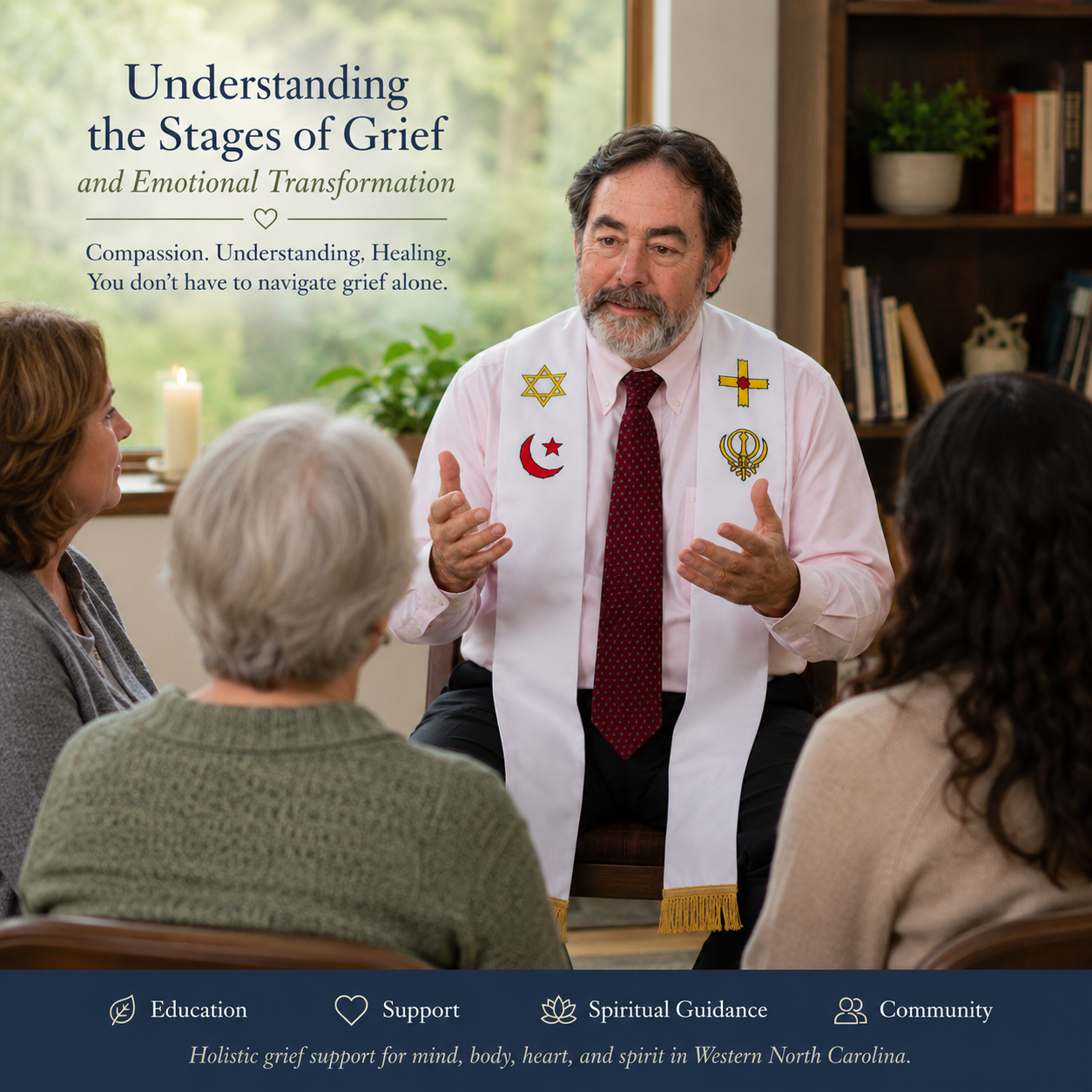
- Reverend Gary Shapiro provides compassionate grief support for individuals throughout Asheville, Hendersonville, Western North Carolina, and online.
What Are the Stages of Grief?
When people experience the loss of a loved one, relationship, career, identity, health, or significant life chapter, grief often brings a wide range of emotions.
The concept of the “stages of grief” became widely known through the work of psychiatrist Elisabeth Kübler-Ross. While originally developed to describe the experiences of individuals facing terminal illness, the model has since helped many people better understand their emotional responses to loss.
It is important to remember:
Grief is not a checklist.
Most people do not move neatly from one stage to the next.
Instead, grief often unfolds in waves, circles, and seasons.
You may experience multiple emotions simultaneously or revisit certain feelings long after you believed you had moved beyond them.
Understanding Emotional Transformation Through Grief
Grief is not only about loss.
It is also about transformation.
Loss changes us.
The person who emerges after profound loss is often different than the person who entered it.
While grief can be painful, it may also invite:
- Greater compassion
- Deeper self-awareness
- New perspectives
- Spiritual growth
- Renewed priorities
- Increased appreciation for life
- Meaningful personal transformation
Healing does not mean forgetting.
Healing means learning how to carry loss while continuing to live fully.
The Five Common Stages of Grief
Denial
Denial often acts as an emotional buffer when loss first occurs.
People may think:
- This cannot be happening.
- There must be some mistake.
- I cannot believe they are gone.
Denial is not dishonesty.
It is the mind’s way of protecting us from being overwhelmed all at once.
Helpful Practices
- Allow yourself time to absorb the reality of the loss.
- Focus on daily routines and self-care.
- Accept that shock and disbelief are normal responses.
Anger
As reality settles in, frustration and anger may arise.
Anger may be directed toward:
- circumstances
- medical systems
- family members
- oneself
- spiritual beliefs
- the person who died
Anger often reflects the depth of our pain and attachment.
Helpful Practices
- Express feelings through journaling or conversation.
- Engage in physical movement.
- Practice self-compassion rather than self-judgment.
Bargaining
Bargaining often involves replaying events and imagining alternative outcomes.
Thoughts may include:
- If only I had…
- What if I had done something differently?
- Maybe things could have changed.
Bargaining reflects our desire to regain control during a situation that feels uncontrollable.
Helpful Practices
- Notice self-blame with compassion.
- Focus on what was within your control and what was not.
- Practice forgiveness toward yourself when appropriate.
Sadness and Depression
This stage often brings deep sorrow and emotional heaviness.
People may experience:
- crying
- fatigue
- loneliness
- loss of motivation
- changes in appetite
- disrupted sleep
These experiences are often normal grief responses.
Helpful Practices
- Stay connected to supportive people.
- Allow emotions to move through naturally.
- Seek grief counseling or support groups if needed.
- Maintain gentle routines.
Acceptance
Acceptance does not mean being “okay” with the loss.
It means recognizing the reality of what has happened and beginning to integrate it into your life story.
Acceptance may include:
- remembering with love rather than only pain
- creating new routines
- finding meaning after loss
- re-engaging with life
Acceptance often arrives gradually.
Grief Beyond the Traditional Stages
Many grief experts now recognize that grief extends beyond the original stage model.
People often experience:
Meaning-Making
Asking questions such as:
- What does this loss teach me?
- How can I honor this person’s memory?
- What matters most now?
Continuing Bonds
Maintaining an ongoing relationship with the memory and influence of the person who died.
Spiritual Exploration
Many people encounter profound spiritual questions following significant loss.
Some feel drawn toward:
- meditation
- prayer
- nature connection
- ritual
- contemplation
- interfaith spiritual guidance
Others may question beliefs they once held.
All of these responses are normal.
Holistic Approaches to Emotional Healing
Grief affects every aspect of our being.
Holistic grief support recognizes emotional, mental, physical, and spiritual dimensions of healing.
Mindfulness and Meditation
Mindfulness can help create space for difficult emotions without becoming overwhelmed by them.
Ritual and Remembrance
Lighting candles, creating memorial spaces, writing letters, or participating in meaningful ceremonies can support healing.
Creative Expression
Art, music, poetry, storytelling, and journaling often help express feelings that words alone cannot capture.
Spiritual Counseling
For many individuals, grief raises questions about meaning, purpose, connection, and spiritual understanding.
Interfaith spiritual counseling can provide compassionate support while honoring each person’s beliefs and experiences.
You may also find support through:
Practical Steps for Navigating Grief
Consider these gentle practices:
✅ Allow yourself to feel what you feel
✅ Practice patience with your healing process
✅ Connect with supportive people
✅ Spend time in nature
✅ Maintain healthy routines
✅ Explore creative expression
✅ Seek support when needed
✅ Honor the memory of what has been lost
There is no perfect way to grieve.
There is only your way.
When Additional Support May Be Helpful
You do not need to navigate grief alone.
Professional grief support may be beneficial if:
- grief feels persistently overwhelming
- daily functioning is significantly affected
- isolation is increasing
- life transitions feel difficult to navigate
- spiritual questions feel particularly challenging
Reverend Gary offers compassionate grief support and spiritual counseling that honors diverse spiritual, religious, and secular perspectives.
Through personalized support, individuals can explore healing, meaning, resilience, and emotional transformation after loss.
Ready for Support?
Grief can feel overwhelming, but healing is possible.
Whether you are navigating recent loss, life transition, or long-term grief, Reverend Gary provides compassionate support grounded in presence, respect, and understanding.
Contact Reverend Gary to schedule a consultation and learn more about grief support services in Asheville, Hendersonville, Western North Carolina, or online.
Frequently Asked Questions
Are the stages of grief experienced in order?
Not necessarily. Most people move between emotions in a non-linear way. You may revisit certain feelings multiple times throughout your healing journey.
What if I do not experience all five stages?
That is completely normal. The stages of grief are a framework, not a requirement. Every person’s grief experience is unique.
How long does emotional healing take after loss?
There is no universal timeline. Healing often unfolds gradually and may continue for months or years depending on the nature of the loss and individual circumstances.
Can grief lead to personal growth?
Yes. While grief is painful, many people eventually discover greater compassion, resilience, wisdom, and purpose through their healing journey.
Is grief support available virtually?
Yes. Reverend Gary offers virtual grief support and counseling sessions, allowing individuals to receive compassionate guidance from wherever they are located.
Grief Support with Rev. Gary Shapiro
For more information on Rev. Gary’s Services, visit the home page and explore more!